
Updated on June 2, 2026
Figuring out the right spray foam thickness for your Arkansas home can get confusing fast. One contractor may give you an inch number. Another may talk about R-value. A third may mention climate zones. The truth is, all three matter.
Arkansas’ state energy code requires R-30 insulation in attics statewide. That is the minimum needed to pass inspection, not the most efficient target. ENERGY STAR recommendations are higher and reflect climate differences between Little Rock, Jonesboro, Springdale, and other Arkansas communities.
Adding too much spray foam can waste money without major comfort gains. Adding too little can leave you paying more than needed in heating and cooling costs. This guide explains state standards, ENERGY STAR recommendations, and inch-by-inch thickness ranges for key areas of the home.
Not sure how your home’s insulation compares? A professional inspection can help you get back on track.
How Arkansas Code & Climate Zones Shape the Right Thickness
Arkansas currently uses the 2014 Arkansas Energy Code, based on the 2009 IECC with state amendments. Little Rock and Jonesboro fall into Arkansas IECC climate zone 3A, while Springdale and much of Northwest Arkansas fall into Arkansas IECC climate zone 4A. State code requires a minimum of R-30 for ceilings/attics, R-13 for wood-frame walls, and R-19 for floors over unconditioned spaces. This is the basic Arkansas Energy Code R-value standard for many projects, and the lowest level a builder can hit and still pass inspection in Little Rock, Jonesboro, or Springdale.

ENERGY STAR’s guidance is more specific because it accounts for colder winters in Northwest Arkansas. For existing homes, Little Rock insulation R-value and Jonesboro insulation R-value targets are R-49 in an uninsulated attic. Springdale insulation R-value targets are R-60. These recommendations exceed code requirements because they focus on comfort, efficiency, and lower energy costs.
Open-Cell vs. Closed-Cell — Why the Same R-Value Needs Different Thicknesses
The main choice is open-cell vs. closed-cell spray foam. Both insulate and air seal, but they perform differently.
Open-cell spray foam
Open-cell foam is lighter, more flexible, more vapor-permeable, and usually more affordable. It is often used in attics, roof decks, and wall cavities with sufficient thickness. Its typical spray foam R-value per inch is about R-3.5.
To hit Arkansas’ R-30 attic minimum, a home needs about 8.5 to 9 inches of open-cell foam. To reach ENERGY STAR’s R-49 target for Little Rock and Jonesboro, about 13.5 to 14 inches is needed. For R-60 levels in Springdale and much of Northwest Arkansas, about 17 inches may be required. That is often impractical in retrofit homes.
Closed-cell spray foam
Closed-cell foam is denser, more rigid, and more moisture resistant. It also has a higher R-value, usually around R-6 to R-7 per inch. That makes it useful in tight spaces, crawl spaces, rim joists, and moisture-prone areas.
To reach R-30, closed-cell foam needs about 5 inches. To reach R-49 in Little Rock or Jonesboro, about 7 to 8 inches is usually enough. For R-60 in Springdale, about 9 to 10 inches is typical.
Choosing the right spray foam insulation option depends on your space, budget, and performance goals.
How Thick by Application Area — Attic, Walls, Crawl Space
Attic / Roof Deck (Highest Impact Area)
The attic is usually the highest-impact place to upgrade insulation in an Arkansas home. Summer roof heat pushes into the living space for hours, especially in Little Rock and Jonesboro. In Northwest Arkansas, winter heat loss can also be a bigger concern.
For attic spray foam thickness in Little Rock and Jonesboro, open-cell foam is often installed around 10 to 14 inches to reach about R-38 to R-49. Closed-cell foam can reach that same range at roughly 5.5 to 8 inches.
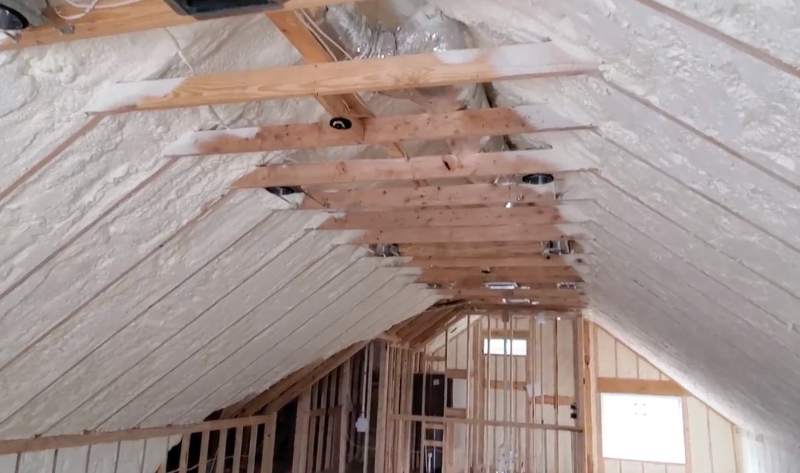
In Springdale and other colder Northwest Arkansas areas, an R-60 target may require about 17 inches of open-cell foam. Since that is not always practical in existing framing, closed-cell foam or a hybrid system may be a better option.
Spray foam also helps with air sealing, improving comfort beyond R-value alone and helping keep your Arkansas home cool in summer and warm in winter.
Exterior Walls (2×4 and 2×6 Framing)
For wall spray foam thickness, framing depth matters. A 2×4 wall cavity is about 3.5 inches deep. About 3 inches of open-cell foam provides R-10.5, while 2 inches of closed-cell foam provides R-13. That lines up with the common Arkansas wall code minimum.
A 2×6 wall has more room. About 5 inches of open-cell foam can achieve R-17.5. Closed-cell foam may also be used in a hybrid wall system when stronger air sealing or a higher R-value is needed.
ENERGY STAR also recommends continuous insulation when walls are opened during re-siding, especially in Zone 3A and Zone 4A homes.
Crawl Space Walls, Rim Joists & Floors
For crawl space insulation, closed-cell foam is preferred. Arkansas crawl spaces are prone to humidity, air leaks, and ground moisture, so open-cell foam is not usually the best fit below ground level.
At rim and band joists, 2 to 3 inches of closed-cell foam can provide R-12 to R-21 while sealing one of the home’s leakiest spots. On crawl space walls, 2 inches of closed-cell foam can often reach about R-13.
Frequently Asked Questions
Get the Right Fit for Your Arkansas Home
The right spray foam thickness is not a set number. It depends on foam type, target R-value, climate zone, and the part of the home being insulated. For most Arkansas homeowners, the highest-return upgrade is bringing attic insulation up to ENERGY STAR’s recommended R-value level instead of stopping at the R-30 code minimum.
At G&S Insulating, we have served Arkansas homeowners since 2001. Our local installation teams in Little Rock, Springdale, and Jonesboro understand our heat, humidity, and winter swings. For insulation solutions for your existing Arkansas home, contact our team today for a clear insulation recommendation and a job done right.
References
Arkansas Department of Energy and Environment. “Building Energy Code.” Office of Energy, State of Arkansas, www.adeq.state.ar.us/energy/initiatives/building.aspx
ENERGY STAR. “Methodology for Estimated Energy Savings from Sealing and Insulating.” U.S. Environmental Protection Agency, www.energystar.gov/saveathome/seal_insulate/methodology
ENERGY STAR. “Recommended Home Insulation R–Values.” U.S. Environmental Protection Agency, www.energystar.gov/saveathome/seal_insulate/identify-problems-you-want-fix/diy-checks-inspections/insulation-r-values
North American Insulation Manufacturers Association. “2014 Arkansas Energy Code: Summary of Key Residential Energy Code Requirements” NAIMA, https://insulationinstitute.org/wp-content/uploads/2025/05/N136-AR-Energy-Code-0425.pdf
Oak Ridge National Laboratory. “Spray Foam in Accessible Spaces.” ORNL/TM-2011/437, U.S. Department of Energy, https://info.ornl.gov/sites/publications/files/Pub33053.pdf
Pacific Northwest National Laboratory. “Climate Zone Map from IECC 2021.” Building America Solution Center, U.S. Department of Energy, https://basc.pnnl.gov/images/climate-zone-map-iecc-2021
U.S. Department of Energy. “Insulation.” Energy Saver, www.energy.gov/energysaver/insulation
U.S. Department of Energy. “Insulation Materials.” Energy Saver, www.energy.gov/energysaver/insulation-materials
U.S. Department of Energy. “Types of Insulation.” Energy Saver, www.energy.gov/energysaver/types-insulation
U.S. Department of Energy Building Energy Codes Program. “Arkansas.” State Energy Code Methodology, www.energycodes.gov/status/states/arkansas